Hydro Flexibility Valuation Tool
A medium-complex, open-source model that balances the need for utility-buy-in with the need to be transparent and practical in relicensing
Hydro Flexibility Valuation Tool
The Hydro Flexibility Valuation Tool (HFVT) is an advanced optimization platform designed to maximize revenue for hydroelectric operations while respecting environmental and operational constraints.
This open-source model bridges the gap between utility requirements and practical relicensing needs. It employs sophisticated algorithms to analyze flow rates, power generation capabilities, and market prices to determine optimal dispatch strategies.
Key capabilities include:
- ✓ Revenue-based dispatch optimization
- ✓ Environmental flow compliance
- ✓ Ramping rate management
- ✓ Interactive visualization of results
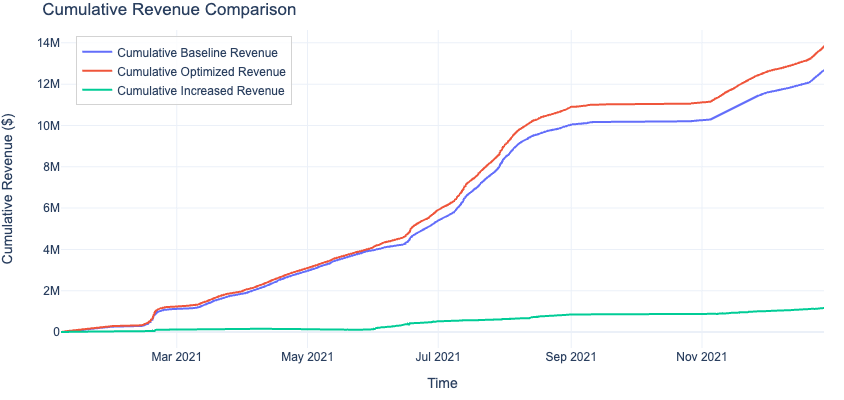
This chart demonstrates the cumulative revenue comparison between baseline and optimized operations, showing how strategic dispatch decisions can increase overall revenue while maintaining environmental compliance.
This chart demonstrates the cumulative revenue comparison between baseline and optimized operations, showing how strategic dispatch decisions can increase overall revenue while maintaining environmental compliance.
Limitations of HFVT
While powerful, it's important to understand the assumptions and limitations of the optimization model:
- ✓ Optimization maintains conservation of daily flow, redistributing water within each day rather than between days. This makes the model suitable for dams with even small reservoir capacity but not for run-of-river assets with no storage. However, battery storage systems can be integrated with run-of-river facilities to achieve similar flexibility benefits.
- ✓ Perfect price foresight assumption in the optimization window
- ✓ Simplified representation of hydroelectric operations without detailed equipment constraints
- ✓ Focus on single-reservoir systems without cascade effects
- ✓ Deterministic optimization without consideration of uncertainty in inflows or prices
- ✓ Only day-ahead locational marginal prices (LMPs) are considered in the optimization
- ✓ No consideration for ancillary services revenue streams
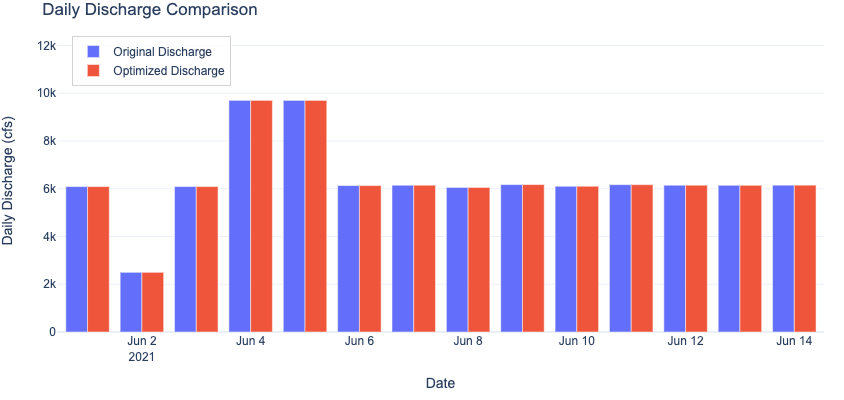
The daily flow results visualization shows how the optimization model conserves daily flow by redistributing water throughout the day. This approach requires some storage capacity, making it suitable for dams with reservoirs but not for run-of-river facilities without storage capabilities. However, battery storage systems can provide this flexibility for run-of-river facilities.
The daily flow results visualization shows how the optimization model conserves daily flow by redistributing water throughout the day. This approach requires some storage capacity, making it suitable for dams with reservoirs but not for run-of-river facilities without storage capabilities. However, battery storage systems can provide this flexibility for run-of-river facilities.